
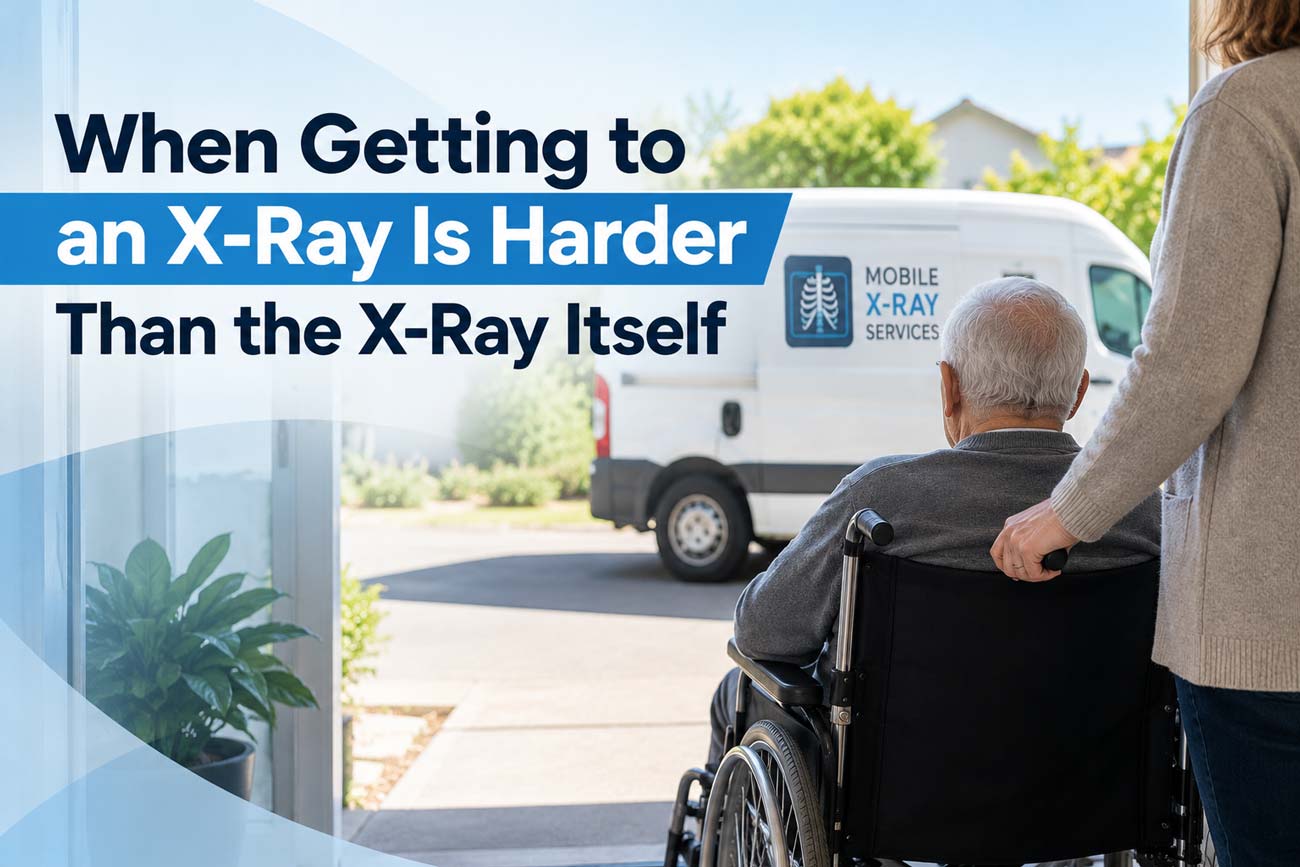
22 Oct When Getting to an X-Ray Is Harder Than the X-Ray Itself
Mobile X-Ray Services: Making Diagnostic Imaging Easier for Patients Who Struggle to Travel
For most people, having an X-ray is a relatively straightforward experience. They arrange an appointment, travel to a radiology facility, undergo a short examination and return home. But for many New Zealanders, the most difficult part of receiving diagnostic imaging has nothing to do with the X-ray itself. It is everything that happens before and after it.
Imagine being elderly, recovering from surgery, living with a disability or experiencing a medical condition that makes movement painful. A simple trip to a radiology clinic can suddenly become a major undertaking. Transport needs to be arranged, caregivers may need to assist, mobility equipment must be organised, and the physical demands of travelling can leave patients exhausted before their examination even begins.
This is where mobile X-ray services are changing the way diagnostic imaging is delivered. Rather than expecting every patient to travel to a traditional radiology facility, portable radiology equipment allows qualified radiographers to bring professional X-ray examinations directly to the patient’s location. Whether someone is recovering at home, living in an aged-care facility or receiving ongoing medical support, mobile imaging can remove one of the biggest obstacles to accessing essential healthcare.
Across Auckland, Hamilton and selected parts of the Waikato, portable diagnostic imaging is helping make healthcare more accessible, practical and patient-focused. It represents a different way of thinking about medical services: instead of asking how patients can reach healthcare, we can begin asking how healthcare can reach patients.
When a Simple X-Ray Appointment Becomes a Major Challenge
Why travelling to a radiology clinic is not always straightforward
For a healthy, mobile person, attending an X-ray appointment may involve little more than driving to a clinic and waiting for their name to be called. For someone with limited mobility, however, the same journey can involve hours of preparation, physical assistance and considerable discomfort.
An elderly patient who relies on a walking frame may struggle to get into a vehicle. Someone recovering from a hip injury may find sitting through a car journey painful. A person confined to bed might require specialist transport and several people to assist with moving them safely. Even relatively short journeys can become physically demanding when a patient is frail or unwell.
These difficulties can be compounded by practical considerations such as parking, wheelchair access, appointment delays and the availability of family members or caregivers. What appears to be a routine medical examination can quickly become an exhausting experience.
Mobile radiology offers an alternative by bringing the examination to the patient. Using compact digital X-ray equipment, experienced radiographers can perform suitable diagnostic examinations in homes, rest homes and other healthcare environments. This can significantly reduce the preparation, travel and physical effort associated with conventional appointments.
The overlooked emotional impact of medical travel
Physical discomfort is only one part of the problem. Medical appointments can also create anxiety, particularly for older patients, people with cognitive difficulties or individuals who have experienced previous hospitalisation.
Unfamiliar surroundings, busy waiting areas, transport arrangements and uncertainty about the examination can all contribute to stress. Patients who are already dealing with illness or injury may find these additional pressures particularly difficult.
For people living with dementia or other cognitive conditions, changes to familiar routines can sometimes cause confusion and distress. Travelling to an unfamiliar medical facility may be more challenging than receiving an examination in surroundings they recognise.
Mobile X-ray services can help reduce these pressures by allowing patients to remain in a familiar environment. A radiographer can explain the examination, position the equipment appropriately and complete the required images without the patient having to undertake an unnecessary journey.
The benefit extends beyond convenience. It supports a more considerate approach to healthcare that recognises the patient’s emotional wellbeing alongside their medical requirements.
Why Moving the Equipment Makes More Sense Than Moving the Patient
How portable X-ray technology changes the traditional approach
For decades, diagnostic radiology was closely associated with large, fixed equipment installed inside hospitals and specialist imaging centres. Patients travelled to these facilities because the technology was difficult to move.
Modern portable digital X-ray technology has changed what is possible.
Compact radiographic equipment can now be transported to suitable locations and used to capture diagnostic images without requiring the patient to attend a conventional radiology department. Digital detectors and imaging systems allow radiographers to acquire images efficiently and assess their technical quality before completing an examination.
The underlying principles of X-ray imaging remain the same. X-rays pass through the body and are absorbed differently by bones, soft tissues and other structures, creating images that help healthcare professionals investigate injuries and medical conditions.
What changes is the location of the examination.
Rather than transporting a patient who may be in pain, physically vulnerable or difficult to move, the necessary equipment is brought to them. This approach can be especially valuable when the patient requires a standard X-ray examination that can be safely and effectively performed using portable equipment.
Can mobile X-rays provide the same diagnostic quality?
One of the most common questions about portable imaging is whether a mobile examination can produce images suitable for clinical diagnosis.
Modern digital radiography systems are capable of producing high-quality diagnostic X-ray images when used correctly. Qualified radiographers follow established imaging techniques, positioning requirements and radiation safety procedures to obtain the views requested by the referring healthcare professional.
The resulting images can then be reviewed and reported by a radiologist, allowing the referring clinician to use the findings when making decisions about patient care.
However, mobile imaging is not appropriate for every examination. Certain specialist procedures require equipment or positioning that cannot be provided in a home or bedside setting. Patient size, mobility, clinical condition and the specific images requested can also influence whether portable imaging is suitable.
A professional mobile X-ray provider assesses these considerations before proceeding, ensuring the examination is appropriate for the patient’s circumstances.
The objective is not simply to make X-rays more convenient. It is to provide clinically useful diagnostic imaging while reducing unnecessary disruption to the patient.

The Patients Who Benefit Most from Mobile Diagnostic Imaging
Supporting elderly patients and people living in aged-care facilities
Older adults are among the groups who may benefit considerably from mobile radiology services.
Age-related changes in mobility, chronic medical conditions and increased vulnerability to injury can make travelling to imaging facilities difficult. For residents of retirement villages and aged-care facilities, arranging an external appointment may also require assistance from staff, family members and transport providers.
A mobile X-ray examination can often be performed in the resident’s room or another suitable area within the facility. Depending on the examination, patients may be able to remain seated or lying in bed, reducing the need for unnecessary transfers.
This approach can be particularly helpful when investigating suspected fractures, certain chest conditions or other concerns for which a clinician has requested plain-film radiography.
For aged-care providers, mobile imaging can also simplify the coordination of medical appointments. Staff can continue supporting residents in familiar surroundings while the radiographer completes the required examination.
Mobile imaging does not replace emergency medical assessment or hospital care when these are clinically necessary. Instead, it provides an additional option for patients whose diagnostic needs can be appropriately managed outside a traditional imaging facility.
Helping patients recovering from injuries, surgery or illness
Recovery from an injury or medical procedure can be physically demanding. Even when a patient is well enough to remain at home, movement may still be restricted by pain, weakness, fatigue or medical instructions.
Travelling to a radiology appointment can place additional demands on someone who is already recovering. Getting dressed, entering a vehicle, sitting for an extended period and moving between locations may all cause discomfort.
When clinically appropriate, a home X-ray can reduce these difficulties.
For example, a patient recovering from an injury may require follow-up imaging requested by their treating clinician. If the examination is suitable for portable radiography, the imaging can potentially be performed at home without the patient having to undertake a difficult journey.
This can be particularly useful for people who require assistance with mobility or who have limited access to suitable transport.
The decision to use mobile imaging should always be guided by the patient’s clinical requirements and the type of examination needed.
Making diagnostic imaging more accessible for people with disabilities
Accessibility is an essential part of modern healthcare, yet traditional medical environments do not always accommodate every patient’s needs equally.
People living with physical disabilities may encounter difficulties with transport, transfers, positioning and navigating unfamiliar facilities. Others may experience sensory sensitivities, communication challenges or conditions that make lengthy appointments difficult.
Mobile X-ray services can offer greater flexibility by allowing examinations to take place in environments that are already familiar and accessible to the patient.
The radiographer can assess the available space, discuss positioning requirements and work with caregivers where appropriate to help complete the examination safely.
Although not every examination can be performed in every environment, portable imaging provides an important additional pathway for people who might otherwise face significant barriers to diagnostic healthcare.
The Hidden Costs of Getting to a Radiology Appointment
Why the true cost of medical travel goes beyond the examination fee
When people consider the cost of an X-ray, they often focus on the price of the examination itself. However, the total cost of attending a medical appointment can extend much further.
Transport expenses, parking, time away from employment and the need for caregiver assistance can all contribute to the financial burden. For patients who require specialist vehicles or additional support, the arrangements can become even more complicated.
Family members may need to take time away from work to accompany a relative. Care facilities may need to coordinate transport and staffing. Patients living outside major urban centres can face additional travel distances.
These indirect costs are easy to overlook because they do not necessarily appear on the radiology invoice.
Mobile X-ray services may reduce some of these expenses by eliminating the need for the patient to travel. However, portable examinations can involve additional service or travel charges, meaning the overall financial benefit depends on the patient’s circumstances.
The most useful comparison is therefore not always between the price of a mobile X-ray and a conventional X-ray. It is between the total cost and practical impact of each option.
How mobile radiology can reduce disruption for families and caregivers
When someone becomes unwell or loses mobility, medical appointments frequently become a shared responsibility.
Partners, adult children, relatives and professional caregivers may all become involved in arranging transport, managing appointments and providing physical assistance.
For families balancing employment, childcare and other commitments, coordinating a hospital or radiology visit can create additional pressure.
A mobile X-ray appointment may simplify these arrangements by allowing the patient to remain at home or within their usual care environment.
Instead of organising transport and accompanying the patient to an external facility, family members can focus on providing support during the examination and communicating with the referring healthcare professional.
This does not remove every responsibility associated with medical care, but it can make an important part of the process easier to manage.
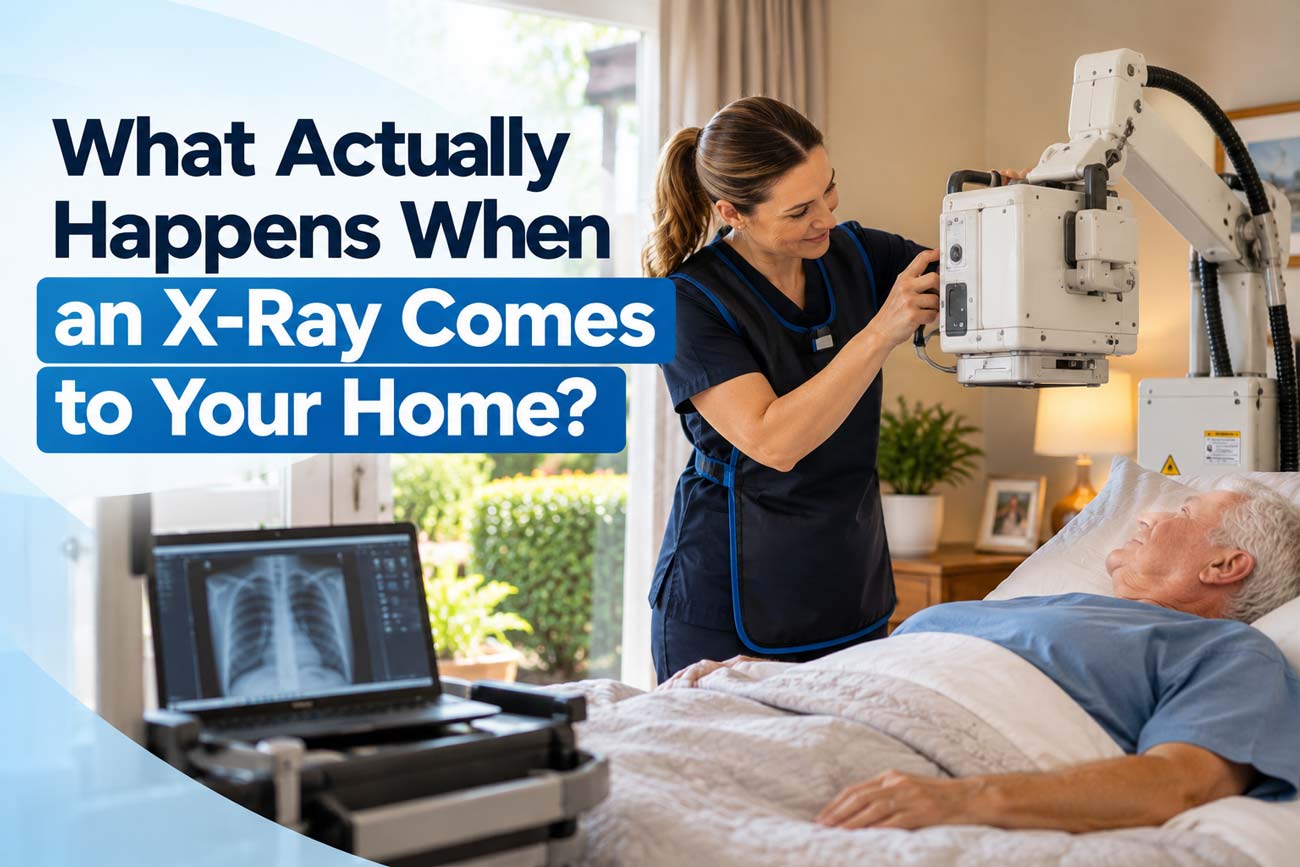
What Actually Happens When an X-Ray Comes to Your Home?
From medical referral to the arrival of the radiographer
The process of arranging a mobile X-ray is generally straightforward, although the clinical requirements of the examination must first be established.
The patient’s doctor or another authorised healthcare professional determines whether diagnostic imaging is necessary and requests the appropriate examination.
Once the imaging requirements have been established, the patient, caregiver or healthcare provider can contact the mobile radiology service to organise an appointment.
The provider confirms the examination requirements, patient location and any relevant mobility or accessibility considerations. This helps determine whether the requested images can be obtained safely using portable equipment.
On the day of the appointment, a qualified radiographer travels to the nominated location with the necessary equipment.
Unlike a conventional radiology appointment, there is no need for the patient to travel to a separate imaging facility.
What patients can expect during the examination
When the radiographer arrives, they assess the available space and prepare the equipment for the requested examination.
Portable X-ray units are designed to be compact and manoeuvrable, allowing them to be positioned in many bedrooms, living areas and healthcare settings.
Depending on the examination, the patient may be asked to sit, stand or lie in a particular position. Some patients can be examined while remaining in their usual bed or chair, provided the required images can be obtained safely.
The radiographer explains what is happening and provides instructions to help the patient remain still while the images are captured.
The actual X-ray exposure takes only a brief moment. However, positioning, preparation and checking the images require additional time.
A typical mobile examination takes approximately 15 to 30 minutes, although the time required depends on the examination and the patient’s individual needs.
Following the examination, the digital images are made available for radiological reporting. The completed report is then provided to the referring healthcare professional, who discusses the findings and any necessary next steps with the patient.
The process is designed to make portable X-ray examinations for patients more accessible while maintaining professional diagnostic standards.
Why Mobile X-Rays Are Becoming an Important Part of Patient-Centred Healthcare
Healthcare should adapt to the patient, not always the other way around
For many years, healthcare delivery has largely been organised around fixed facilities. Hospitals, specialist clinics and diagnostic centres provide essential services, but patients are generally expected to travel to these locations.
While this system works well for many people, it can create significant difficulties for those with restricted mobility or complex care requirements.
Mobile healthcare challenges the assumption that every examination must take place in a dedicated medical building.
By moving suitable diagnostic services into homes and care environments, healthcare providers can offer greater flexibility without abandoning established clinical standards.
The principle is simple: where an examination can be performed safely and effectively outside a traditional radiology facility, the patient may not need to travel.
This is particularly relevant as New Zealand’s population ages and demand for accessible healthcare continues.
Portable radiology can help support community-based care, allowing appropriate diagnostic examinations to be completed closer to where patients live.
The importance of maintaining professional radiology standards
Convenience should never come at the expense of patient safety or diagnostic quality.
Mobile X-ray examinations must be performed by appropriately qualified professionals using suitable equipment and established radiation protection procedures.
Radiographers assess the patient’s positioning, select appropriate exposure settings and take precautions to protect the patient and other people nearby.
New Zealand’s radiation safety requirements apply to diagnostic radiology, including the use of portable equipment. These requirements help ensure X-ray examinations are justified, conducted appropriately and performed with radiation exposure kept as low as reasonably practicable while obtaining clinically useful images.
Once the examination is completed, the images must be suitable for interpretation by a radiologist.
The value of mobile radiology lies in combining professional diagnostic standards with a more accessible method of delivering care.
Patients should not have to choose between convenience and quality when an appropriate mobile imaging option is available.
Mobile X-Ray Services Across Auckland, Hamilton and Waikato
Bringing professional diagnostic imaging closer to patients
Access to healthcare can vary considerably depending on where someone lives, their mobility and the services available nearby.
In larger urban areas, patients may have several radiology facilities within reasonable travelling distance. However, proximity does not necessarily make those facilities accessible to someone who cannot easily leave home.
A clinic located only a few kilometres away may still be difficult to reach for a bedridden patient or someone who requires specialist transport.
Mobile X-ray services help address this problem by providing diagnostic imaging at suitable locations throughout the communities they serve.
Portable X-Ray Services provides mobile radiographic examinations across greater Auckland, Hamilton and selected parts of the Waikato, supporting patients in private homes, retirement villages, aged-care facilities and other healthcare settings.
Using fully portable digital radiography equipment, qualified radiographers can perform suitable X-ray examinations at the patient’s location.
This helps reduce the need for unnecessary travel while allowing referring healthcare professionals to access diagnostic information that supports ongoing patient care.
Choosing the right mobile radiology provider
When arranging portable diagnostic imaging, patients and healthcare professionals should consider more than convenience alone.
An established provider should have appropriately qualified radiographers, reliable digital imaging equipment, clear referral procedures and access to professional radiological reporting.
It is also important to confirm whether the required examination can be performed at the patient’s location.
Some X-ray procedures require specialised equipment or positioning that may not be possible with portable systems. A responsible provider will explain these limitations and advise when an alternative imaging arrangement is necessary.
Patients should also ask about appointment availability, expected reporting times, service areas and applicable fees before confirming a booking.
Clear communication is especially important when patients have mobility restrictions, cognitive conditions or additional care requirements.
By understanding these factors in advance, patients and caregivers can make informed decisions about the most appropriate imaging option.
Conclusion: Sometimes Better Healthcare Begins by Removing the Journey
An X-ray examination may take only a short time, but getting to that examination can be an entirely different challenge.
For elderly patients, people with disabilities, those recovering from injuries and individuals living with complex medical conditions, the journey to a radiology facility can involve pain, stress, expense and considerable organisation.
Mobile X-ray services offer a practical alternative by bringing professional diagnostic imaging directly to suitable patient locations.
The technology does not eliminate the need for hospitals or conventional radiology departments. Nor can every examination be performed outside a dedicated imaging facility. What it does provide is greater flexibility for patients whose needs can be safely met through portable radiography.
Perhaps the most important change is not technological at all. It is the recognition that accessible healthcare should consider the whole patient experience, not simply the examination being performed.
For patients and caregivers across Auckland, Hamilton and selected parts of the Waikato, Portable X-Ray Services offers a more convenient way to access appropriate diagnostic imaging without unnecessary travel.
If you or someone you care for requires an X-ray but travelling to a radiology clinic presents difficulties, contact Portable X-Ray Services to discuss the examination requirements, available appointment options and how mobile radiology can support your needs.
Because sometimes the best way to make healthcare more accessible is simply to bring it to the people who need it.